
Field note
Stewardship Begins in the Field
Stewardship in humanitarian work requires more than funding and logistics.
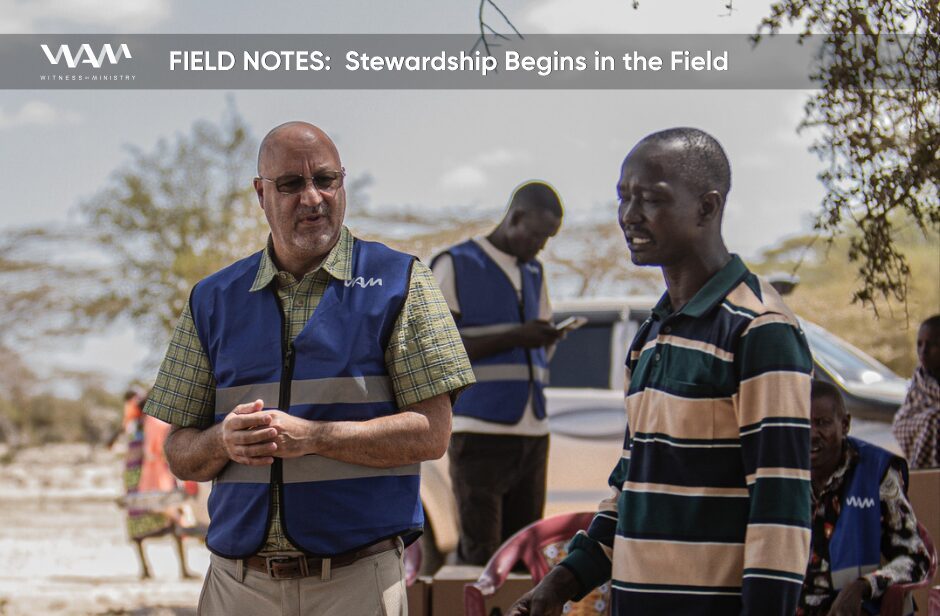
The note
Field-informed perspectives on humanitarian response and operational leadership.
Humanitarian stewardship is often evaluated through financial reporting, compliance measures, and distribution metrics. Although these elements remain essential, effective stewardship in complex humanitarian environments also depends upon operational proximity, trusted local partnerships, and informed field leadership.
Organizations responding to conflict, displacement, economic instability, and infrastructure collapse must operate with situational awareness that extends beyond centralized planning. Conditions in crisis-affected regions evolve rapidly. Access routes change. Supply chains become unstable. Community needs shift faster than formal reporting cycles can often capture.
Field-informed humanitarian leadership strengthens an organization’s ability to adapt responsibly within these environments.
Insights from the Field
Effective humanitarian response depends upon more than logistics capacity alone. Sustainable operations require organizations to remain closely connected to local realities, regional dynamics, and community-based partnerships capable of informing response decisions in real time.
Operational proximity improves accountability.
Organizations maintaining long-term regional presence and trusted local networks are often better positioned to identify emerging needs, evaluate operational risks, and sustain continuity during periods of instability. Leadership informed by direct field engagement also strengthens decision-making related to resource allocation, supply chain management, program adaptation, and response prioritization.
Stewardship within humanitarian operations extends beyond financial oversight. Responsible stewardship also includes protecting trust, maintaining operational consistency, and ensuring that humanitarian response remains informed by realities on the ground rather than assumptions developed from a distance.
Long-term humanitarian effectiveness requires balancing emergency response with resilience-focused development strategies. Immediate aid remains essential during crisis. However, sustainable humanitarian operations must also consider food security, medical access, education continuity, infrastructure recovery, and local capacity-building.
Informing the Response
Field-informed leadership directly shapes the quality, adaptability, and sustainability of humanitarian response operations.
Organizations operating in rapidly changing environments must continuously evaluate logistical constraints, access limitations, partnership structures, and evolving community needs. Accountability becomes stronger when operational leadership remains sufficiently connected to field conditions to respond with consistency and informed flexibility.
Humanitarian challenges across the Middle East and beyond continue to increase in complexity. Effective response therefore requires organizations capable of combining operational agility with long-term regional understanding and sustained local engagement.
Stewardship is not solely measured by the delivery of aid. Stewardship is also reflected in the systems, partnerships, and operational practices that enable humanitarian organizations to respond responsibly, adapt effectively, and maintain trust over time.
WAM INC. | Witness as Ministry is uniquely positioned to launch an immediate humanitarian response when disaster strikes the Middle East and Africa. Our leadership team offers decades of experience stewarding resources for efficient and effective aid delivery. Contact us at info@wamcares.org.
Published 22 May 2026. The text is as WAM first published it.
Stand with us
WAM remains in places the coverage has left. A gift to Witness As Ministry is what keeps someone there.
Together, we can provide Care Beyond Crisis.